Factoring vs. Trade Finance: Where Do They Overlap?
Factoring vs. Trade Finance: Where Do They Overlap? Expert insights for UK businesses on trade finance and financial solutions.
Factoring vs. Trade Finance: Where Do They Overlap?
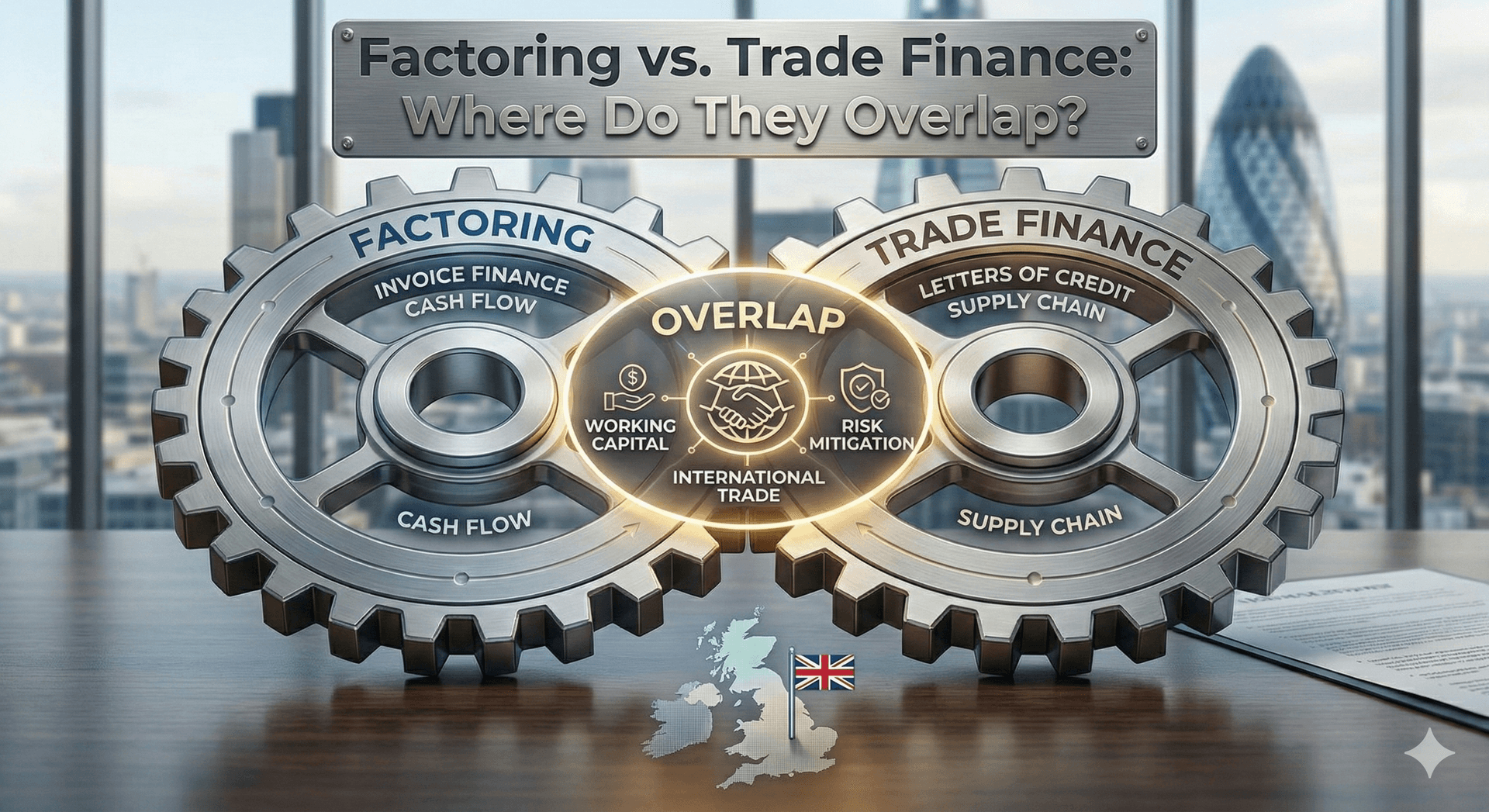
What’s the relationship between factoring and trade finance, and where do these two funding solutions intersect? Factoring and trade finance aren’t mutually exclusive – they’re complementary tools that often overlap in practice. While factoring focuses on converting unpaid invoices into immediate cash, trade finance encompasses broader funding solutions for international commerce, including letters of credit, export finance, and supply chain funding. Many UK businesses use both simultaneously, with factoring handling domestic receivables whilst trade finance solutions support international transactions. The overlap occurs particularly in export factoring, where factoring companies provide both invoice financing and credit protection for overseas sales.
The boundaries between these funding methods have become increasingly blurred as financial providers expand their offerings. Understanding where they complement each other can help your business build a more effective financing strategy.
What is Trade Finance?
Trade finance represents the financial instruments and products that facilitate international and domestic trade transactions. It’s essentially the oil that keeps the wheels of commerce turning smoothly.
At its core, trade finance bridges the gap between when goods are shipped and when payment is received. This might sound straightforward, but the reality involves multiple parties, currencies, regulations, and risks that make simple transactions quite complex.
The main categories include:
- Documentary credits (letters of credit) that guarantee payment upon document presentation
- Trade loans providing working capital for inventory and production
- Export finance supporting overseas sales with longer payment terms
- Supply chain finance optimising cash flow across entire trading relationships
- Trade credit insurance protecting against buyer default
UK businesses engaged in international trade typically use these tools to manage cash flow gaps, mitigate risks, and offer competitive payment terms to customers. The sector has grown significantly, with UK international trade values exceeding £1.896 billion in 2025 [ONS].
What is Factoring?
Factoring involves selling your unpaid invoices to a specialist company (the factor) in exchange for immediate cash. Rather than waiting 30, 60, or 90 days for customers to pay, you receive typically 80-90% of the invoice value within 24 hours.
The factoring company then collects payment directly from your customers. Once collected, they remit the remaining balance minus their fees, which usually range from 0.5% to 3% of the invoice value depending on various risk factors.
Two main types dominate the UK market:
Recourse factoring means you remain liable if customers don’t pay. It’s cheaper but leaves you carrying the credit risk.
Non-recourse factoring transfers the bad debt risk to the factor, providing additional protection but at higher cost.
Many factors also offer additional services like credit checking, collections management, and sales ledger administration. This can be particularly valuable for growing businesses that lack sophisticated credit control systems.
How Trade Finance and Factoring Work Together
The intersection becomes clearer when you examine specific business scenarios. A Manchester-based textile manufacturer might use a letter of credit to secure fabric imports from India, whilst simultaneously factoring invoices from UK retail customers to maintain cash flow during the production cycle.
Here’s how the overlap typically works:
Export factoring represents the most obvious convergence point. When selling overseas, businesses face extended payment terms and additional risks. Export factors provide immediate funding against international invoices whilst often including credit insurance coverage.
Supply chain integration creates another overlap area. Modern trade finance providers increasingly offer factoring as part of broader supply chain solutions, helping businesses manage both supplier payments and customer receivables within integrated platforms.
Working capital optimisation brings both tools together strategically. Smart businesses use trade finance to fund inventory and production, then deploy factoring to accelerate cash conversion from resulting sales.
The process might look like this for a typical UK exporter:
- Secure trade finance facility to fund raw materials and production
- Manufacture goods and ship to international customers
- Factor the resulting export invoices for immediate cash flow
- Use proceeds to repay trade finance and fund next production cycle
Benefits of Using Both Solutions
Combining factoring with trade finance creates several advantages that neither solution delivers alone.
Enhanced cash flow predictability tops the list. Trade finance helps you plan production and inventory cycles, whilst factoring eliminates uncertainty around collection timing. Together, they create more stable working capital management.
Risk diversification becomes more sophisticated when using multiple tools. Export credit insurance through trade finance protects against country risks, whilst factoring can include domestic credit protection. This layered approach reduces overall exposure.
Competitive positioning improves significantly. Trade finance enables you to offer attractive payment terms to international customers, whilst factoring ensures these extended terms don’t damage your cash flow. Many UK exporters find this combination essential for competing against overseas suppliers.
Operational efficiency benefits from integrated solutions. Rather than managing separate relationships with trade financiers and factors, many providers now offer combined services under single facilities.
Cost optimisation often emerges through bundled pricing. Providers may offer preferential rates when businesses use multiple products, though this requires careful analysis to ensure genuine savings.
Costs and Considerations
Understanding the cost structure proves crucial for effective decision-making. Trade finance and factoring each carry distinct fee structures that can interact in complex ways.
Trade finance costs typically include:
- Arrangement fees: 0.5-2% of facility size
- Usage fees: 1-4% per annum above base rate
- Document handling charges: £50-200 per transaction
- Amendment fees: £100-500 depending on complexity
Factoring costs generally comprise:
- Service fees: 0.5-3% of turnover factored
- Interest charges: 2-8% above base rate on advances
- Credit protection premiums: 0.1-0.5% of protected turnover
- Setup and administration fees: £500-2,000 annually
When combining both solutions, watch for:
Double financing scenarios where you’re paying interest on the same working capital through different routes. This sometimes happens with poorly structured facilities.
Conflicting security requirements can create complications. Trade financiers and factors both typically want charges over receivables, requiring careful legal structuring.
Concentration risks may increase if both facilities depend heavily on the same customer base or geographic markets.
Currency mismatches need careful management when factoring foreign currency invoices whilst maintaining sterling-based trade finance facilities.
Is This Combination Right for Your Business?
Several factors determine whether combining factoring with trade finance makes sense for your specific situation.
Business size and complexity matter significantly. Smaller businesses with simple trading patterns might find the administrative overhead outweighs benefits. However, companies with £2 million+ turnover often discover meaningful advantages.
International exposure represents perhaps the strongest indicator. Businesses with substantial export sales or complex supply chains typically benefit most from integrated approaches.
Industry characteristics influence suitability considerably. Manufacturing businesses with long production cycles often need both tools, whilst service companies might require only factoring.
Customer base diversity affects the equation. Companies serving many smaller customers usually benefit more from factoring, whilst those with fewer, larger clients might prefer trade finance solutions.
Growth trajectory plays a crucial role. Rapidly expanding businesses often outgrow single financing solutions, making combined approaches increasingly attractive.
Consider these warning signs that suggest you might need both:
- Cash flow gaps exceeding 60 days regularly
- International sales representing over 25% of turnover
- Inventory requirements exceeding £500,000
- Customer payment terms extending beyond 45 days
- Seasonal trading patterns creating working capital stress
Frequently Asked Questions
What’s the main difference between export factoring and traditional trade finance?
Export factoring provides immediate cash against overseas invoices with optional credit protection, whilst traditional trade finance encompasses broader funding solutions including letters of credit, trade loans, and documentary collections. Export factoring is typically faster and more flexible, but trade finance offers greater transaction security and wider acceptance globally. Costs vary significantly, with export factoring fees ranging from 1-3% of invoice value compared to trade finance charges of 2-6% annually.
Can I use both factoring and a letter of credit simultaneously?
Yes, but coordination is essential. You can factor invoices arising from letter of credit transactions once goods are shipped and documents presented. However, the factor needs to understand the LC terms and may require the credit to be advised through them. This arrangement works particularly well for confirmed letters of credit where payment risk is minimal. Costs typically increase by 0.2-0.5% due to additional complexity.
How do currency fluctuations affect combined trade finance and factoring arrangements?
Currency exposure varies depending on structure. If you factor foreign currency invoices, you’re typically protected against exchange rate movements as factors usually convert to sterling immediately. However, trade finance facilities in foreign currencies create ongoing exposure. Many providers offer currency hedging services, but these add 0.1-0.3% to overall costs. Sterling-based businesses should budget for potential currency impacts of 2-5% annually.
What documentation do I need for combined facilities?
Expect extensive paperwork including audited accounts for the past three years, detailed cash flow forecasts, customer aging reports, and trade references. International businesses need additional documentation such as export licenses, shipping records, and country risk assessments. Legal documentation typically takes 4-6 weeks to complete and costs £3,000-8,000 in professional fees. Ongoing reporting requirements are usually monthly for both facilities.
Are there minimum turnover requirements for using both solutions together?
Most providers require annual turnover of at least £1-2 million for combined facilities, though some specialist lenders work with smaller businesses. Trade finance typically needs minimum transaction sizes of £50,000-100,000, whilst factoring usually requires monthly sales of £100,000+. Businesses below these thresholds might access products separately but miss out on preferential pricing available through integrated arrangements.
How quickly can I access funds through combined arrangements?
Initial setup takes 6-12 weeks for full underwriting and documentation. Once established, factoring advances are typically available within 24 hours of invoice submission, whilst trade finance draws can take 3-5 working days depending on documentation requirements. Emergency funding might be available same-day for established clients, though this usually carries premium pricing of 1-2% above standard rates.
What happens if my customer disputes an invoice that’s been factored and trade financed?
Dispute resolution becomes more complex with multiple parties involved. Under recourse factoring, you remain liable regardless of disputes, whilst non-recourse factoring may provide protection depending on dispute nature. Trade finance providers typically require clean documentation, so disputes affecting document compliance can impact facility availability. Resolution usually takes 30-90 days and may require temporary alternative funding arrangements.
Can I factor invoices from customers in high-risk countries?
This depends on your factor’s risk appetite and country limits. Most UK factors are comfortable with EU, North American, and major Asian markets, but may decline or require credit insurance for higher-risk territories. Country limits typically range from £50,000-500,000 per territory. Trade finance can help by providing additional security through instruments like letters of credit, making previously unfactorable invoices acceptable.
How do seasonal businesses benefit from combining these solutions?
Seasonal businesses often need trade finance during quiet periods to fund inventory and production, then use factoring during peak seasons to accelerate cash collection. This creates natural working capital cycles that complement each other. Many providers offer seasonal facilities with lower commitments during off-peak periods. Costs can be optimised by timing facility usage appropriately, potentially saving 1-3% annually compared to year-round arrangements.
What are the exit requirements if I want to terminate combined facilities?
Exit procedures vary by provider but typically require 90-180 days’ notice. Outstanding advances must be repaid, and you’ll need alternative arrangements for collecting factored invoices. Trade finance facilities usually allow earlier termination upon repayment of outstanding drawings, though commitment fees may apply. Legal costs for facility termination typically range from £1,000-3,000, and you may face early termination penalties of 1-2% of facility size.
References and Data Sources
Industry Statistics and Market Data
- UK Finance Annual Trade Finance Survey 2025
- British Business Bank SME Finance Markets Report 2026
- Asset Based Finance Association UK Market Statistics 2025
Regulatory and Compliance Information
- Financial Conduct Authority Trade Finance Guidance 2025
- HM Treasury Export Finance Policy Framework 2026
- UK Export Finance Annual Report and Accounts 2025
Cost and Fee Data
- British Business Bank Cost of Finance Survey 2025
- Asset Based Finance Association Pricing Benchmarks 2026
- UK Finance SME Lending Data 2025
Professional and Industry Sources
- Institute of Export & International Trade Research 2026
- Chartered Institute of Credit Management Industry Survey 2025
- British Chambers of Commerce Trade Finance Report 2026
Information accurate as of January 2026. Market conditions and specific terms vary by provider. Costs and availability depend on individual business circumstances and creditworthiness. This content is for informational purposes only and should not be considered financial advice.
Ready to explore how factoring and trade finance could work together for your business? Our comparison tool helps you evaluate options from leading UK providers, showing real costs and terms based on your specific requirements. Get personalised quotes in minutes and discover which combination of solutions best fits your trading needs.
Ready to compare trade finance providers?
Compare quotes from leading UK trade finance providers in 60 seconds. No obligation, completely free.
Ready to Get Started?
Compare quotes from leading UK factoring providers and find the best rates for your business.
Get Your QuotesRelated Articles